Most hotel websites are not broken. They load properly, look professional, and technically do what they were designed to do. On the surface, everything appears to be working.
And that is exactly the problem.
In today’s digital landscape, “good enough” websites rarely fail in obvious ways. Instead, they underperform quietly, costing hotels revenue without triggering clear red flags. Because nothing is technically wrong, it is easy to assume nothing needs to change.
the hidden cost of standing still
Guest expectations are evolving faster than many hotel websites.
Search behavior has shifted. booking journeys are no longer linear. AI-powered discovery tools are changing how travelers find, evaluate, and compare hotels. At the same time, many hotel websites are still operating as static information hubs rather than active conversion tools.
That disconnect creates friction throughout the booking journey. Not because guests cannot find what they need, but because the experience does not proactively guide them toward a decision. Over time, that friction translates into lost opportunities that are difficult to attribute to any single issue.
where “good enough” starts to fall short
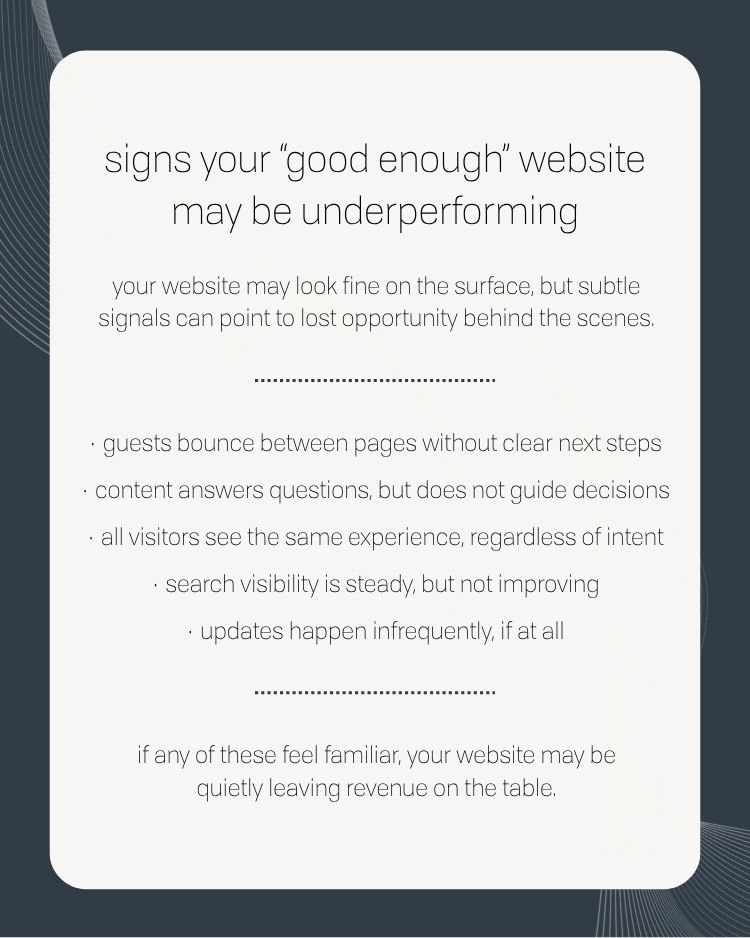
A website can look polished and still struggle at critical moments that influence booking decisions. The symptoms are often subtle, which is why they are easy to ignore.
Content may answer common questions but fail to anticipate guest intent. Pages may be visually appealing but not structured for modern search or AI-driven discovery. Every visitor may see the same experience, regardless of where they are in the booking journey. Calls to action may exist but remain static, even as guest behavior changes.
Individually, these challenges can seem minor. Collectively, they create friction at scale, especially for hotels competing for direct bookings in crowded markets.
conversion is no longer a single moment
Hotel websites were once judged by a simple outcome: Did the guest book or not?
Today, conversion happens over time. Guests compare properties, leave to explore other options, return through different channels, and search again using new language and new tools. They expect clarity, confidence, and relevance at every step of that process.
Websites designed to simply exist online are not built for this reality. Without ongoing optimization and strategic intent, they struggle to support the modern booking journey.
visibility is changing too
Search is no longer limited to traditional rankings and keyword placement. AI-driven platforms increasingly influence how hotel information is surfaced, summarized, and recommended to travelers.
Websites that are not actively structured and maintained for this shift may still appear online, but not always in the moments or contexts that matter most. Over time, visibility erodes quietly, even if traffic numbers appear stable.
the partner difference
This is where the difference between a vendor and a partner becomes clear.
Vendors deliver websites. Partners stay accountable for performance.
A partner looks beyond launch day and continues asking hard questions. Is the website adapting to how guests search today? Is it supporting visibility in emerging discovery channels? Is it improving clarity and confidence for prospective guests over time?
“Good enough” websites are often the result of one‑and‑done thinking. High‑performing websites are the product of ongoing collaboration, iteration, and alignment with real business goals.
why this matters now
Hotels are competing in a more crowded and complex digital environment than ever before. Standing still is no longer neutral. It is a disadvantage.
Websites that are not actively evolving may not raise alarms, but they quietly reduce direct booking potential, visibility, and guest confidence. Over time, those small losses add up.